Languages
Intent
Learning a foreign language is a liberation from insularity and provides an opening to other cultures. The 2014 National Curriculum for Modern Foreign Languages aims to ensure that all children:
- Understand and respond to spoken and written language from a variety of authentic sources.
- Are able to speak with increasing confidence, fluency and spontaneity, finding ways of communicating what they want to say, including through discussion and asking questions, and that they are continually improving the accuracy of their pronunciation and intonation.
- Can write at varying length, for different purposes and audiences, using the variety of grammatical structures that they have learnt.
- Discover and develop an appreciation of a range of writing in the language studied.
A high-quality languages education should foster children’s curiosity and deepen their understanding of the world. At Ditchling, we are committed to ensuring that teaching enables pupils to express their ideas and thoughts in another language and to understand and respond to its speakers, both in speech and in writing. We recognise that competence in another language enables children to interpret, create and exchange meaning within and across cultures.
At Ditchling we are committed to ensuring our MFL teaching provides the foundation for learning further languages, as well as the means to access international opportunities for study and work later in life. The exposure to MFL in EYFS and KS1 and the teaching of MFL in KS2 provides an appropriate balance of spoken and written language and lays the foundations for further foreign language teaching at KS3.
Implementation
Children are introduced to French in Nursery through 30 minute weekly lessons. Throughout KS1, children receive exposure to languages through our Modern Foreign Language Day, collective worships, watching the French nativity and, in year 2, exploring French through short 30 minutes lessons each week in Term 6. In KS2, each class has a timetabled French lesson of up to 45 minutes (swapping to additional languages in Term 6).
Lessons across the Key Stages support the skills of speaking, listening, reading and writing:
- Children are taught to listen attentively to spoken language and respond, joining in with songs, rhymes and games.
- Links have been developed with Downlands Secondary School.
- Children develop an appreciation of a variety of stories, songs, poems and rhymes in French that are delivered through the curriculum content, as well as by fluent French speakers within the wider school community.
- We follow the primary MFL scheme of work from Language Angels.
- Whole school celebrations like European Languages Day and events such as our year 4 French Nativity enables the whole school to be immersed in the inclusion of the culture and use the language, meaningfully, in context.
- Links with the French Institute in London have been established to help deepen Year 6’s understanding of French culture.
Each new unit of work begins with a recap of the previous related knowledge from previous years. This helps children to retrieve what they have learned in the earlier sequence of the programme of study, and ensures that new knowledge is taught in the context of previous learning to promote a shift in long-term memory. Key vocabulary for the new topic is also introduced as part of the sequence of learning. This provides definitions and accompanying visuals for each word to ensure accessibility to all. This approach also means that children are able to understand the new vocabulary when it is used in teaching and learning activities and apply it themselves when they approach their work. A focus on phonics is key to each year’s work and progression, and is revisited at least twice each academic year.
Knowledge and skills in French are progressive from one year to the next and are mapped across the school, in line with the Language Angels scheme of work. Cross-curricular links have been identified and the school’s own context is considered as part of curriculum planning, including, for example, how the grounds of the school and local resources can be used to enhance and enrich French learning.
Impact
Our MFL curriculum ensures that children develop their knowledge of where different languages, including the range of home languages spoken by the families of the school, as well as French, are spoken in the world.
Varied learning experiences, including translated prayers in alternative languages and European Languages Day also ensure that languages are celebrated throughout the school community whilst providing a context for language learning and develop the children’s understanding of different cultures and confidence in speaking in another language. Learning foreign languages teaches skills that are transferable to other areas of the curriculum – it helps to improve memory, attention and concentration, thus helping pupils problem solve and improve executive function.
Through MFL education, we cultivate global citizens who are better prepared to navigate an interconnected world, fostering empathy, tolerance, and collaboration.
-
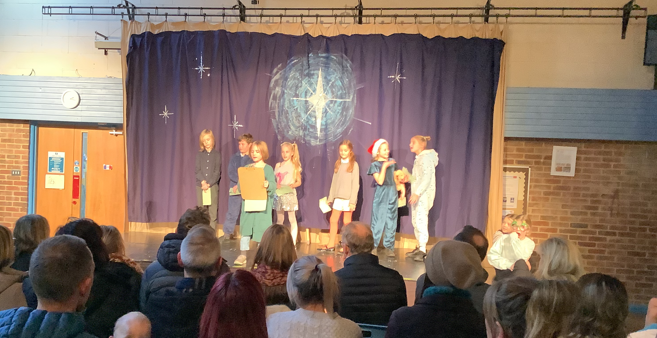
- Year 4 get to perform a French nativity which is a great opportunity for pronunciation practice!
-

- Year 4 get to perform a French nativity which is a great opportunity for pronunciation practice!
-

- We like to explore different languages wherever possible – this was a collective worship where we had to guess which language some songs were being sung in.
-
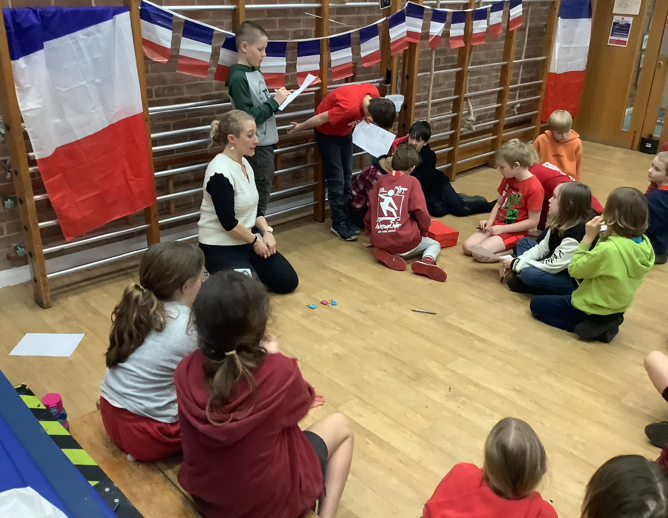
- Every year we have a French day where we do lots of different activities in French – sometimes we learn about French books, sometimes sport and leisure activities, and once we had to solve a lot of clues about the Paris metro system.
